On October 1, 2026, GB 44703‑2024 General Requirements for Optical‑Radiation Safety, a mandatory national standard, officially came into force, marking the most important turning point for China’s stage laser and cultural‑tourism night‑time laser projection industries. The new regulation applies to all laser‑and‑light devices accessible to the public. Optical‑radiation safety assessments are now added across the full workflow, covering factory‑outgoing equipment inspection, project construction acceptance, and performance approval procedures. A large number of legacy older laser devices will need retrofitting or replacement, as they fail to meet the mandatory safety criteria. For contractors, scenic spots and cultural‑tourism project operators, compliance has become the primary threshold for laser project implementation and the hottest topic in the current laser projector sector.
Driven by policy, the cultural‑tourism night‑experience market keeps expanding. Projects for cliff‑face illumination, historic‑building lighting, urban landmarks, bridges, riverways and ancient‑tree lighting keep launching. Fog‑based northern‑light effects, building‑outline tracing and naked‑eye 3D laser shows remain crowd‑drawing highlights for scenic destinations. Multiple night‑time light‑and‑shadow projects set new visitor‑flow records during the National Day holiday. Local cultural‑tourism authorities keep increasing support for immersive digital light‑and‑shadow hardware, encouraging scenic spots to boost the night‑time economy and fueling demand for laser‑projector upgrades. Market requirements are no longer focused merely on high power output; demand has shifted toward high‑power outdoor laser products featuring lightweight build, all‑weather waterproofing, reliable low‑failure performance and regulatory compliance.
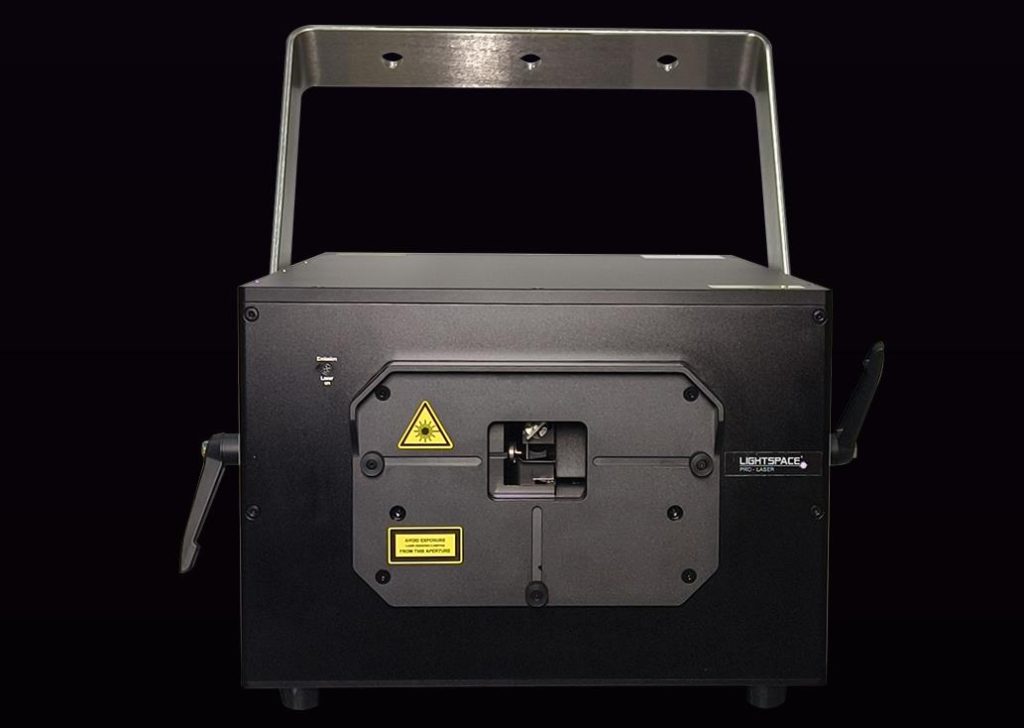
Conventional high‑power outdoor laser projectors generally feature bulky housings, difficult hoisting and high aerial‑construction costs. In outdoor conditions with large day‑night temperature swings, lens condensation and fogging frequently occur, undermining stability during long‑duration continuous operation. Addressing these industry pain points, Lightspace has launched the Unicorn 100W Ultra‑Lightweight Waterproof Laser Projector, the flagship model of the Unicorn series, redefining high‑power outdoor laser engineering equipment. Compared with traditional models of equivalent power, the Unicorn 100W features a drastically reduced overall footprint and lightweight construction, lowering barriers for transportation and aerial hoisting and cutting on‑site labor costs for installation. Equipped with a high‑speed galvanometer system delivering galvanometer speeds up to 26 Kpps, it supports complex animations and fast beam transitions for smooth, jag‑free light‑and‑shadow visuals, ideal for large‑scale light performances on mountain landscapes, urban landmarks and major music festivals.
In terms of protection performance, the Unicorn 100W Ultra‑Lightweight Waterproof Laser Projector achieves IP66 high‑level ingress protection and incorporates a constant‑temperature anti‑condensation system. It effectively mitigates lens condensation triggered by outdoor day‑night temperature fluctuations and delivers stable long‑run continuous operation amid heavy rain, sand‑dust and extreme temperatures, perfectly suited for all‑weather deployments including urban landmark shows, mountain‑projection spectacles, bridge night‑view projects and outdoor electronic music festivals. Moreover, the product is strictly aligned with GB 44703‑2024 optical‑radiation safety national standard, with complete safety‑test documentation to satisfy compliance requirements for domestic cultural‑tourism project acceptance and performance approval. For export scenarios, it conforms to the international safety standard IEC 62471 and supports CE certification audits for overseas projects.
On the technical front, large‑scale immersive roaming night‑tour and music‑festival projects are being progressively deployed. For control protocols, deep integration of ArtNet, FB4 and ILDA enables multi‑unit cluster synchronization and simplifies deployment for large multi‑node light‑and‑shadow installations. Meanwhile, domestic laser equipment accelerates import substitution, with local‑manufactured models growing more competitive in performance, delivery lead‑times and after‑sales maintenance services.
For overseas markets, PLASA 2026, the international stage‑lighting exhibition, sends a clear signal: laser light sources have evolved from stage‑effect accessories into mainstream luminaires for arena tours and large‑scale music festivals. Nevertheless, laser‑safety regulations keep tightening across global territories. The EU and other regions have lowered permissible laser‑brightness limits. Export orders require full optical‑radiation safety test reports; non‑compliant products cannot complete customs clearance and certification.
Notable industry‑wide challenges persist. Severe price competition plagues the mid‑to‑low‑end laser‑projector segment. Products competing solely on low price struggle to pass new‑standard acceptance checks and suffer frequent field failures. More engineering contractors and clients now prioritize branded offerings with safety certifications, proven long‑term stability and comprehensive after‑sales support.
In summary for the 2026 laser‑projector industry: compliance forms the baseline, while lightweight design plus high‑grade environmental protection constitute core product competitiveness. The Lightspace Unicorn 100W Ultra‑Lightweight Waterproof Laser Projector combines high power output, lightweight construction, all‑weather reliable operation and full compliance credentials, making it the preferred solution for cultural‑tourism night‑time attractions, urban landmarks and outdoor performance projects. Going forward, as the night‑time‑experience economy continues to grow, safe, stable and easy‑to‑install domestic high‑power laser projectors will further displace imported alternatives and emerge as the mainstream industry choice.